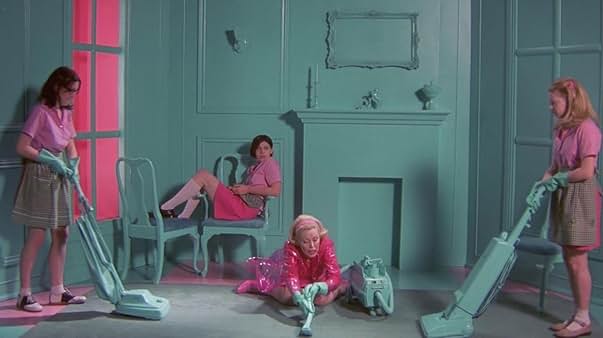
Jamie Babbits But I’m a Cheerleader (1999) is a satirical take on conversion therapies, an unethical practice of dismantling a person gender or sexual identity to fit a heteronormative society, in 1999 following movements such as “Don’t ask, Don’t tell” and the “Defense of Marriage Act” and has become an iconic queer movie. Amongst most early queer cinema, a ‘happy ending’ was never seen. In the same year, 1999, Boys Don’t Cry was released; a powerful drama focusing on the life of a transgender person. But I’m a Cheerleader was a fresh and exciting depiction of queer people, specifically lesbians, in queer cinema. Alongside the issues of homophobia Babbits 1999 feature also surfaces issues of sexism due to the strong links between gender and sexuality and the way lesbianism decentralises men.
From the uniforms to the movements, cheerleading is widely seen as a performance not only of aesthetics but more recently of sexuality and gender, paralleling Judith Butler’s (Gender Trouble: Feminism and the Subversion of Identity 2006) gender performance theory. When looking at the deeper undertones of the conversion therapy, the women are forced into ‘housewife’ roles further pushing the idea of gender performance. In a sense, it is all a theatrical act to please others. This theatrical nature runs throughout and links in with gender most prominently during the end wedding scene. Instead of forcing gender ideology through a pre-established gendered tradition, the conversion camp aims to push this further by putting the women in very evidently costume-like pink dresses and the men in blue suits. This performance seems to transcend any predetermined gender norms and reverts back to gender in its most simple form: pink is for girls, blue is for boys. “cheerleading has served as an icon of normative—meaning white, heterosexual, middle-class, and American—girlhood.” (Grindstaff, L. and West, E. (Cheerleading and the Gendered Politics of Sport 2006)), meaning the existence of Megan goes against societal norms of what it means to be a woman. Her sexuality distances her from her gender while the identity as a cheerleader pulls her back.

The lesbian cheerleader is a very popular trope when it comes to subverting femininity and challenging male perception of women. Cheerleaders follow a ‘Madonna complex’ by being both promiscuous and pure simultaneously, contradictory in itself but even more complex when the women aren’t straight; sometimes not even women at all. The same ideologies apply to lesbians in a different way; due to the male sexualisation of lesbians and lesbian porn, lesbians are often seen as a lot more sexual than straight women. For straight women, purity comes in the form of innocence and naivety, a competition of femininity, obedience, and conformity to the female gender in the context of cheerleaders. Purity within heterosexual women is an implication of not being sexual when they could be; however, purity in lesbianism comes from the longing to not be seen as perverted by simply wanting to exist romantically with another woman. This alone goes beyond dominant views of cheerleaders, where these characteristics would apply in reflection to the star quarterback. Subversion also comes into the authority and popularity cheerleaders have, something notably not held by lesbians in that same way straight women do. In the media, women often harness male desire to gain this authority and popularity, usually by being a cheerleader. It seems as if Megan in But I’m a Cheerleader falls under stereotypes of femininity and sexuality just by simply being a cheerleader, that’s how deep rooted the principles of being a cheerleader are in American society. The title “But I’m a Cheerleader” proves this subversion. The use of the conjunction “but” implies that lesbianism cannot co-exist within cheerleading. Merging a sport that is a beacon of female heterosexuality amplifies the dissonance between femininity and lesbianism, almost showing women and lesbians as two separate genders.
I mean, everybody thinks I’m this big dyke because… ’cause I wear baggy pants, I play softball, and… and I’m not as pretty as other girls, but that doesn’t make me gay.
– Jan, But I’m a Cheerleader (1999)
But I’m a Cheerleader is set many years after the second wave of feminism, a wave that encouraged women’s central focus to not be catered to the needs of men. Entering into the third wave of feminism in the 90s led to a more radical feminist movement, including ‘riot girl’ groups and the rejection of the term ‘feminist’ and therefore the connotations that follow. The connotations put all feminism under a bracket of radical feminism solely focused on the decentralisation of men, which is not true. This places But I’m a Cheerleader at a good time in history where feminism is more focused on an individual relationship to gender and finding identity outside of their male spouse. When discussing links between girlhood and cheerleading, Adams, N. and Bettis, P. (Commanding the Room in Short Skirts: Cheering as the Embodiment of Ideal Girlhood, 2003) offer that “The discourse of ideal girlhood operates to normalise and regulate the behaviours of all girls, even those girls who consciously choose to resist or reject the dominant ideology of normative girlhood.”The “regulation” of Megan’s girlhood comes from her identity as a cheerleader; however, due to her “perverted” nature, she is seen as incorrect through a societal lens. This is seen within the sexual shots of the cheerleaders during practice. Megan carries her pom-pom throughout the movie, reappearing at the end during the heterosexual wedding ceremony, infiltrating an already gendered regime with something feminine yet still holding her identity as a lesbian.
Bo Welch designed the set with the themes of gender and sexuality in mind, which is why semiotics are so prominent throughout the film. The over-the-top use of pink and blue, principally in the conversion camp, encapsulates the absurdity and over-the-top dramatics of how much Mary is willing to push this diluted version of the gender binary onto the queer people attending. Semiotically, But I’m a Cheerleader enhances the entanglement of gender and sexuality. Phallic imagaery is prominent during the army scene with trees reflecting male body parts and cut-outs of soldiers visually resembling male sexual acts. Male sexuality is commonly based in sex whereas sex, in the context of the nineties, was a very taboo topic for women which is why this is not seen subliminally with the women. The Hays Code banned ‘sexual perversion’ in movies under the notion that movies containing this would not get made. The lack of female sexuality in But I’m a Cheerleader may fall under the censorship of lesbianism using the male gaze, a more consumable way to view lesbians. Like most issues of homosexuality, this perception is dangerous, as it creates a dishonest image of lesbians. When lesbians disengage themselves from the male gaze (Mulvey, 1975) and don’t fit into this hypersexual, male fantasy imagery, it leads to violence against lesbians, therefore violence against women. This concept of gender and sexuality could also relate back to the sexist and usually sexual premise of ‘boys will be boys’, whereas women can’t hide under the banner of their gender to dismiss behaviour.
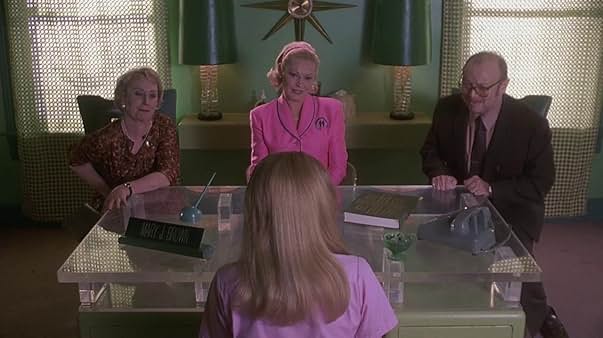
Casting and costuming also play a large role in showing But I’m a Cheerleader in a satirical light; without these elements, But I’m a Cheerleader may have fallen into a different category. Using RuPaul as the head of male conversion shows just how ridiculous the conversion camps are when it comes to changing someone at the core of their being, with mise-en-scène of the largest and most well-known queer icons. Director Jamie Babbit came up with the concept of the movie after reading a news article about a conversion camp and wanted to give a satirical take on society and the obsession with the gender binary. The mise-en-scène creates a very theatrical nature, not only linking back to gender performance but also just to how artificial it all looks, paralleling the artificial nature of heteronormativity in a place that calls homosexuals unnatural. Adding gender to this theatrical performance enhances the movie’s main theme: you cannot change someone, and to try and force change is to make them perform, with lesbians having to perform heteronormativity to fit in. Conversion therapy in itself is seen as ridiculous to a modern audience in the idea that the camp is essentially teaching two women how to live together.
It’s your choice: you can run off with Megan and turn into a raging bull-dyke, or you can do the simulation and graduate and lead a normal life.
– Mary, But I’m a Cheerleader (1999)
Graham is aesthetically defined as a more masculine lesbian, and the contrast between what she wears in the scene at the gay club makes the uniform at the conversion camp look more like a costume—hyper-feminine and unnatural to her character. In Juarez’s essay on gender and sexuality (My Gender is Dyke, 2022), it states, “Society is terrified of women who refuse to be easily consumable, and they’re even more scared of those who aren’t women.” Based on this idea and the integration of gender reformation in the conversion camp, gender is an integral part of upholding heterosexuality and a heteronormative society. However, this concept goes further than sexuality; it descends into women’s position in society, with Westbrook and Schilt (Doing gender, doing heteronormativity, 2009) stating, “Heterosexuality plays a central role in ‘maintaining the gender hierarchy that subordinates women to men.’” As seen through the character of Megan in But I’m a Cheerleader and all of the other women in the conversion camp, being a lesbian removes male control from domestic life. Decentralising men and transgressing social norms using the gender binary in very simple ways contributes to a hatred of lesbians; therefore, women are now becoming a feminist issue rather than one of sexuality.
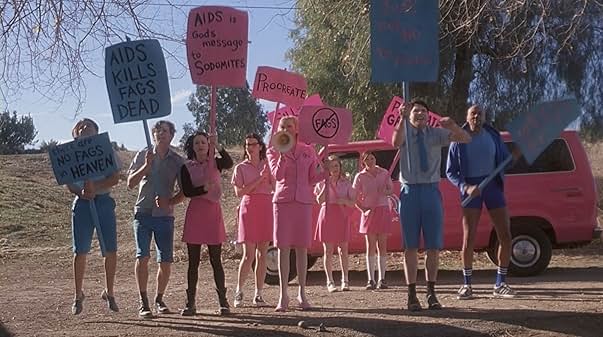
Jan was put into the conversion therapy due to her more masculine traits; however, it is revealed she is not a lesbian. This further shows how interlinked gender and sexuality are and the vitality in understanding and, to an extent, separating the two. By rejecting the male gaze, lesbians then subject themselves to not fitting male ideals. Male ideals for women are fundamentally sexualised, with Susan Brownmiller (Against Our Will: Men, Women and Rape, 1993) stating, “Pornography, like rape, is a male invention, designed to dehumanise women, to reduce the female to an object of sexual access.” This link between the male gaze, pornography and the general respect for women becomes evident when viewing lesbians, especially more masculine presenting ones. Respect is only earned by some men through the promise of sex or at least some possibility, as there is no promise of sex for a man from a lesbian; this leads to a mix of homophobia and sexism. However, men still harness the heavily feminine sexual traits of lesbian porn and in some cases prefer it over straight porn. This further proves the idea that men only show respect to women who fit ideologies of what a woman should be, even a femme lesbian, because the existence of femininity implies the existence of heteronormativity.
The anger stemming from not only homophobia but also the incorporation of sexism and racism leads to the stereotype of the ‘man-hating lesbian’, which is seen frequently in modern media due to the rise of radical feminism. The concept of radical feminism is slowly decreasing in how objectively ‘radical’ these ideologies and movements are. Due to new reproductive rights originating in South Korea and moving to America, women have been joining the 4B movement, essentially a movement where a woman does not engage in sexual activity with a man. Factoring out the concept of sexual attraction, this ‘radical’ movement is simply not fulfilling a man’s sexual fantasy; something masculine-presenting lesbians have not only rejected domestically but socially too. It is the social aspect and the presentation of gender that make concepts such as rejection of female identity as perceived by men a feminist issue.
Ultimately, due to Megan’s identity and lack of desire to adhere to male societal standards, she aligns with more radical feminist ideologies; however, decentralizing men is not necessarily a radical movement, especially when it’s just someone’s sexual and gender identity. Looking at the world in the twenty-first century, decentralizing women is common and often praised among more right-wing men, starting with objectification and moving to taking advantage of them.
bibliography
Adams, N., & Bettis, P. (2003). “Commanding the Room in Short Skirts: Cheering as the Embodiment of Ideal Girlhood.” Gender and Society, 17(1), 73–91. Available at: http://www.jstor.org/stable/3081815
Brownmiller, S. (1993) “Against Our Will: Men, Women and Rape” New York: Fawcett Columbine
Butler, J. (2006). “Gender Trouble: Feminism and the Subversion of Identity” (1st ed.). New York: Routledge.
Grindstaff, L., & West, E. (2006). “Cheerleading and the Gendered Politics of Sport.” Social Problems, 53(4), 500–518. Available at: https://doi.org/10.1525/sp.2006.53.4.500
Mulvey, L. (1975) “Visual Pleasure and Narrative Cinema” Screen, Volume 16, Issue 3, Autumn 1975, Pages 6–18. Available at: https://doi.org/10.1093/screen/16.3.6
SCHILT, K., & WESTBROOK, L. (2009). DOING GENDER, DOING HETERONORMATIVITY: “Gender Normals,” Transgender People, and the Social Maintenance of Heterosexuality. Gender and Society, 23(4), 440–464. Available at: http://www.jstor.org/stable/20676798
Jaurez, A. (2022) “My Gender is Dyke.” Autostraddle available at: https://www.bing.com/ck/a?!&&p=8e74e498e38f0d43df1ac7198b96a68a6cf3c31f1b6ae978d85ae2e2bea8e3e5JmltdHM9MTczNjg5OTIwMA&ptn=3&ver=2&hsh=4&fclid=15ed5b8e-e55a-66ec-190f-49e2e44f6713&psq=my+gender+is+dyke+essay+jstor&u=a1aHR0cHM6Ly93d3cuYXV0b3N0cmFkZGxlLmNvbS9teS1nZW5kZXItaXMtZHlrZS8&ntb=1
 Yellow Flicks
Leave a comment